For over a century, traditional restorative dentistry operated on a mechanical concept borrowed from metallurgy: if a tooth suffered from a deep cavity, a minor fracture, or an aging amalgam filling, the default solution was to grind the tooth down 360 degrees into a small cylindrical peg and cement an artificial full-coverage metal or porcelain crown.
At Consultorio Dental Scott in Polanco, under the clinical leadership of Dr. José Rafael Scott Arellano, we practice and champion biomimetic and minimally invasive dentistry. Modern biological research has proven that amputating sound dental tissue to "protect" a tooth is a clinical paradox that severely shortens its functional lifespan.
The Dilemma of Traditional Crowns: How Much Tooth Is Actually Lost?
Biomechanics studies in restorative dentistry (such as landmark research by Edelhoff & Sorensen) have quantitatively documented the biological cost of full-coverage tooth preparation:
- Removal of 63% to 73% of sound coronal tissue: To provide mechanical retention and thickness for a conventional crown, dentists are forced to grind away perfectly healthy cusps and peripheral enamel.
- Thermal and biological trauma to the dental pulp: High-speed burs generate intense friction and vibration near odontoblast cells. Consequently, 10% to 20% of teeth prepared for full crowns develop pulp necrosis within 5 to 10 years, requiring root canals that further weaken root structural integrity.
- Compromised Ferrule Effect: Short tooth preparations lose structural ferrule, creating stress concentrations that lead to catastrophic vertical root fractures and subsequent tooth loss.
The Biomimetic Revolution: Emulating Nature
The term biomimetics stems from Greek bios (life) and mimesis (imitation). In clinical dentistry, it signifies that nature has already perfected the ideal biomechanical model:
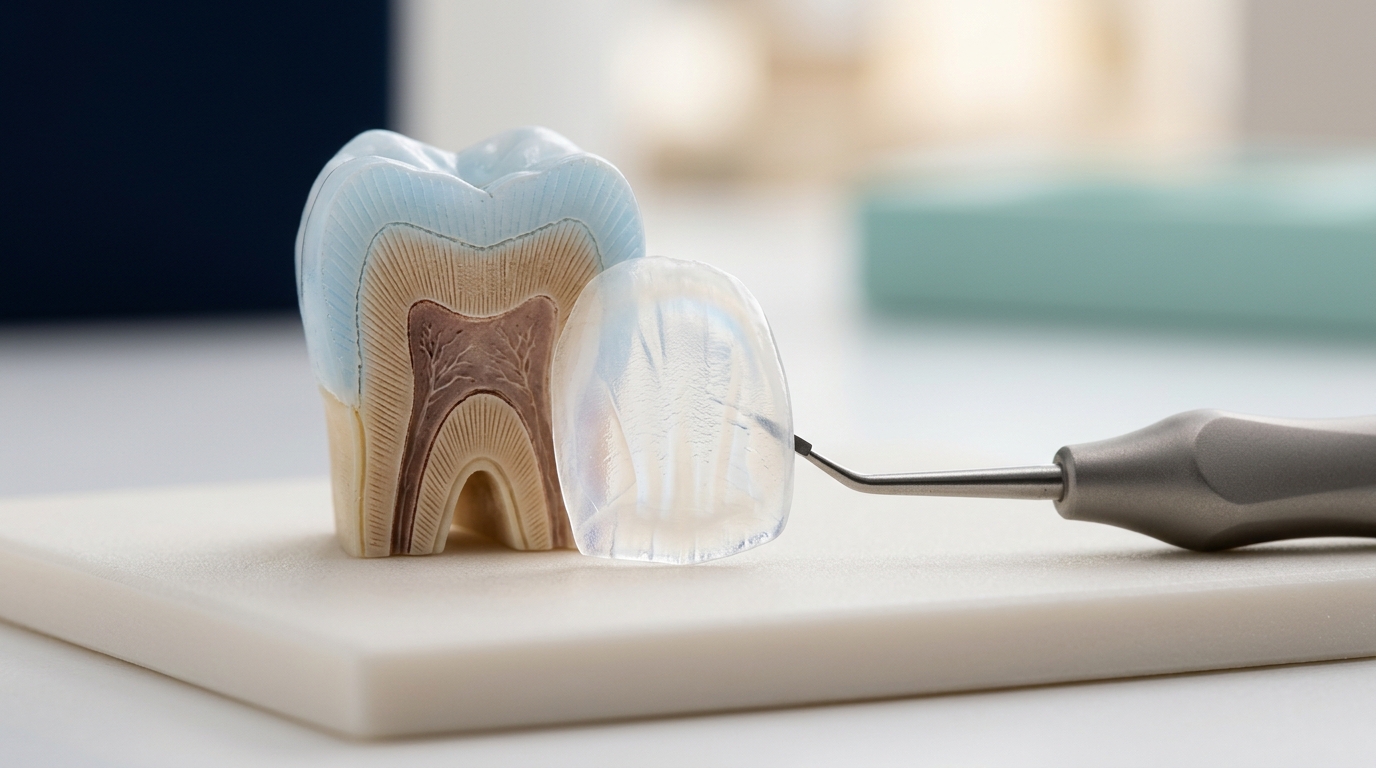
The Enamel-Dentin Complex
Outer enamel is exceptionally hard and rigid, while underlying dentin is elastic, functioning as a natural shock absorber that dissipates chewing forces. Traditional crown dentistry attempts to fix fractures with overly stiff metals or monolithic zirconia cores that transfer peak stresses directly to root tips. In contrast, biomimetic dentistry utilizes bonding systems matching dentin elasticity and lithium disilicate ceramics replicating the fracture toughness of enamel.
Immediate Dentin Sealing (IDS): The Foundation of Clinical Longevity
Pioneered by Dr. Pascal Magne, Immediate Dentin Sealing (IDS) is a cornerstone protocol in biomimetic practice. In traditional preparations, fresh dentin remains unsealed under temporary plastics for weeks, causing bacterial contamination and hyper-sensitivity.
With IDS protocols:
- Dentin is hybridized with medical-grade hydrophobic adhesives immediately upon cavity debridement.
- Dentinal tubules are permanently sealed: zero bacteria, zero cold sensitivity, and zero pulpal stress.
- Micro-tensile bond strengths increase by up to 400% compared to delayed conventional cementation.
Comparison: Biomimetic Dentistry vs. Conventional Full Crowns
| Clinical Parameter | Biomimetic Conservative Dentistry | Traditional Full-Coverage Crown |
|---|---|---|
| Sound Tissue Preservation | Maximal: 90% to 95% of healthy remaining tooth structure is preserved. | Destructive: 63% to 73% of sound coronal tooth volume is shaved away. |
| Risk of Subsequent Root Canal | Under 1%: Pulp is protected immediately via Immediate Dentin Sealing (IDS). | High (10% to 20%): Frictional heat and bur proximity cause nerve necrosis. |
| Retention Mechanism | Molecular micro-mechanical adhesion directly to natural enamel and sealed dentin. | Geometric frictional resistance and passive cementation. |
| Behavior Under Excessive Load | Favorable failure mode: In extreme trauma, the ceramic chips but preserves the root. | Catastrophic failure: Overly rigid crowns cause vertical root fractures. |
| Future Repairability | 100% Repairable: Can be micro-repaired or re-bonded without shaving further tooth structure. | Irreversible: Replacing a crown requires re-prepping and further structural loss. |
Frequently Asked Questions About Conservative Dentistry (FAQ)
Were you advised to get dental crowns and want an honest second medical opinion?
At Consultorio Dental Scott (Homero 205, Polanco, Mexico City), we evaluate your case with high-definition digital X-rays and surgical magnification to explain transparently whether your tooth can be saved while preserving its natural enamel.
Medical Disclaimer: The information provided in this article is for educational and scientific guidance. The suitability of a biomimetic or conservative adhesive restoration depends on remaining structural tooth volume, functional habits (such as bruxism), periodontal health, and individualized occlusal analysis. It does not replace an in-person diagnostic evaluation by a certified specialist at Consultorio Dental Scott (Homero 205, Suite 301, Polanco V Sección, Miguel Hidalgo, Mexico City).