
When a teenager or adult presents with a narrow upper jaw (maxillary transverse deficiency), severe crowding, a posterior crossbite, or dark buccal corridors when smiling, traditional orthodontics historically faced difficult trade-offs: tipping teeth outward into thin gum tissue, extracting healthy premolars, or referring the patient for hospital jaw surgery.
Modern maxillofacial orthopedics offers a predictable, minimally invasive middle ground: the MARPE protocol. At Consultorio Dental Scott Polanco, led in orthodontics by Dr. José Alberto Scott Torres, our priority is educating patients clearly on how this biomechanical protocol works and where its real clinical boundaries lie.
1. Midpalatal Suture Anatomy: Why Treatment Changes With Growth
The upper jaw does not start as one fused piece of bone; it consists of right and left maxillary halves joined down the midline by a fibrous joint called the midpalatal suture.
- In childhood (ages 4 to 11): The suture remains relatively straight and pliable. As detailed in our pediatric maxillofacial orthopedics guide, conventional tooth-borne appliances easily separate the suture.
- In late adolescence and early adulthood: The suture interlocks like puzzle pieces and gradually calcifies. Attempting expansion with a molar-supported screw at this stage mainly tips teeth laterally, risking alveolar bone loss and gum recession without widening the palate itself.
2. How MARPE Achieves True Bone-Borne Expansion
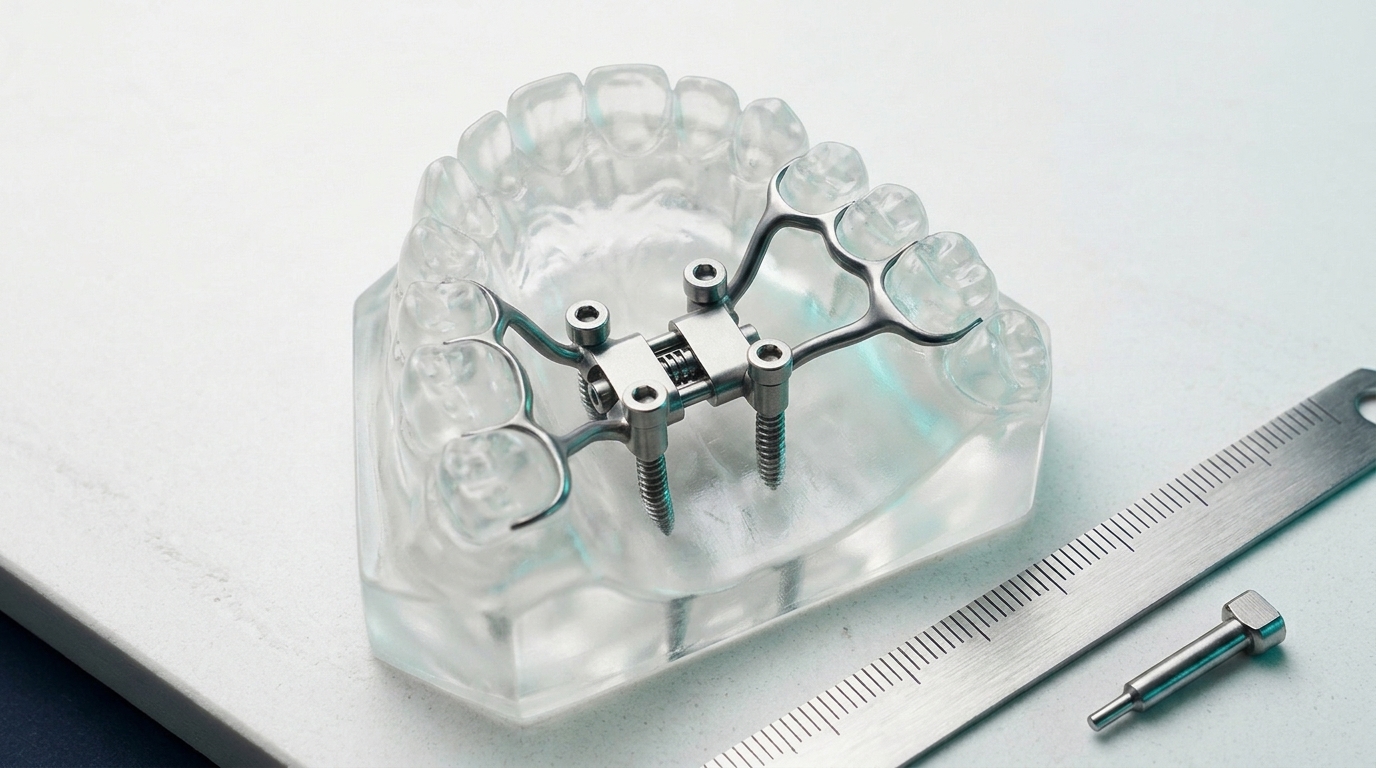
MARPE stands for Miniscrew-Assisted Rapid Palatal Expansion. It transfers expansion forces from a central jackscrew into four bicortical titanium micro-implants positioned on either side of the midpalatal suture.
Parallel, bicortical force vectors
By engaging both the oral cortical plate (palate) and the nasal cortical floor, bicortical TADs apply pure orthopedic tension that produces a parallel anterior-to-posterior separation of the maxillary halves, sparing tooth roots and periodontal support.
3. The Anatomical Link to Nasal Breathing and Sleep Quality
A narrow, high-arched palate is rarely just a cosmetic alignment concern. Anatomically, the roof of your mouth is the floor of your nasal airway.
When the maxilla is constricted, nasal airflow resistance rises, encouraging chronic mouth breathing, snoring, and disrupted sleep. Expanding the maxilla skeletally increases nasal cavity volume and supports smoother nasal breathing, complementing clinical protocols in dental sleep medicine and airway-related sleep bruxism evaluation.
4. Clinical Honesty: Candidates vs. Real Limitations
Ethical dentistry means clearly stating when a procedure does not apply. MARPE is not universal for every adult. Prior to treatment, we evaluate a Cone-Beam CT (CBCT) scan to classify midpalatal suture maturation (Angelieri stages A through E):
- Predictable candidates (Stages A, B, and C): Areas of unossified connective tissue still allow non-surgical suture separation—commonly seen in older teens (13–18) and young adults (19–35).
- Fully fused sutures (Stages D and E): In adults where circummaxillary sutures have completely ossified (particularly frequent in males over 30–35), forcing a non-surgical screw risks TAD bending or cortical fracture. In such cases, SARPE (surgically assisted expansion) or corticotomy-assisted protocols remain the appropriate medical recommendation.
- Subsequent alignment phase: Once new bone mineralizes across the suture (4–6 months), final alignment is completed cleanly using self-ligating braces or 3D direct-printed clear aligners without sacrificing healthy teeth.
Comparison Table: Conventional Expander vs. MARPE vs. Surgical SARPE
| Clinical Parameter | Conventional Expander (Hyrax) | MARPE (Micro-Implants) | SARPE (Surgical) |
|---|---|---|---|
| Indicated Stage | Children (ages 4–11) prior to suture interdigitation. | Teens (12+) and young adults with patent sutures on CBCT. | Adults with fully fused sutures (Stage D/E). |
| Biomechanical Anchor | Tooth-borne (anchored strictly to molars). | Bone-borne (4 titanium TADs in palatal bone). | Bilateral maxillary osteotomy + jackscrew. |
| Periodontal Risk in Adults | High: Dental tipping and risk of gum recession. | Minimal: Force loads palatal bone directly. | Low when gingival health is stable. |
| Nasal Airway Impact | Favorable during childhood growth. | Expands nasal floor and lowers airflow resistance. | Widens nasal cavity in fused adult cases. |
| Setting & Recovery | In-office placement, no anesthesia needed. | In-office (20 min local anesthesia), immediate return to routine. | Hospital operating room under general anesthesia. |
Frequently Asked Questions About MARPE (FAQ)
Dealing with a narrow palate or crowding and looking for an honest diagnostic opinion?
At Consultorio Dental Scott (Homero 205, Polanco), we analyze your 3D CBCT scan, transverse occlusion, and nasal airway anatomy to give you a transparent clinical assessment on whether MARPE is appropriate for your bone stage.
Medical Responsibility Disclaimer: This article is strictly educational and does not replace an in-person clinical evaluation or 3D Cone-Beam CT (CBCT) diagnostics. Candidacy for Miniscrew-Assisted Rapid Palatal Expansion (MARPE) depends on individual midpalatal suture maturation, cortical bone thickness, and craniofacial anatomy evaluated by a certified Orthodontics & Maxillofacial Orthopedics specialist at Consultorio Dental Scott (Homero 205, Suite 301, Polanco V Sección, Miguel Hidalgo, Mexico City).